The U.S. Department of Transportation's (DOT)
Safe System Approach is a holistic approach to addressing roadway safety built on six guiding principles:
- Death and serious injuries are unacceptable
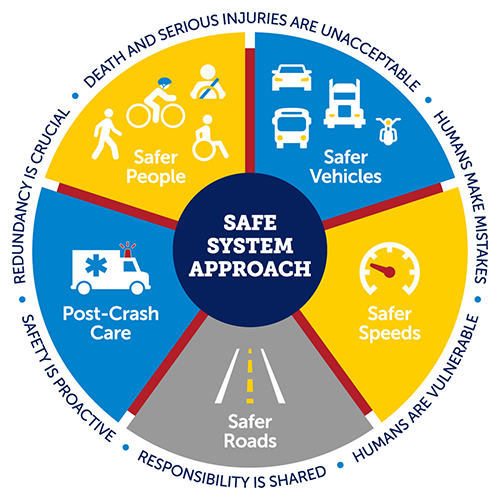
- Humans make mistakes
- Humans are vulnerable
- Responsibility is shared
- Safety is proactive
- Redundancy is Crucial
Five Safe System elements create a comprehensive, holistic approach to addressing roadway safety for all road users:
- Safer People: Encourage safe, responsible driving and behavior by people who use our roads and create conditions that prioritize their ability to reach their destination unharmed.
- Safer Roads: Design roadway environments to mitigate human mistakes and account for injury tolerances, to encourage safer behaviors, and to facilitate safe travel by the most vulnerable users.
- Safer Vehicles: Expand the availability of vehicle systems and features that help to prevent crashes and minimize the impact of crashes on both occupants and non-occupants.
- Safer Speeds: Promote safer speeds in all roadway environments through a combination of thoughtful, equitable, context-appropriate roadway design, appropriate speed-limit setting, targeted education, outreach campaigns, and enforcement.
- Post-Crash Care: Enhance the survivability of crashes through expedient access to emergency medical care, while creating a safe working environment for vital first responders and preventing secondary crashes through robust traffic incident management practices.
The speed in which people drive influences the safety and severity of crashes. Higher speeds can increase the likelihood that a traffic crash will result in serious injury or death
due to the increase in kinetic energy generated from the interaction of vehicles and other roadway users. Safer people, or road users, are created through a combination of
education, behavioral changes, and adherence to safety protocols aimed at reducing traffic fatalities, in which speed management is one of the key elements. Speed
management aims to provide road users an environment in which they voluntarily follow speed limits and reduce speeds, when necessary, for example, in residential areas, near schools, and at dawn/dusk. Context-appropriate speed management decisions and strategies can help control vehicle speeds which can reduce fatal and serious injury crashes on our roadways.