P-19-013
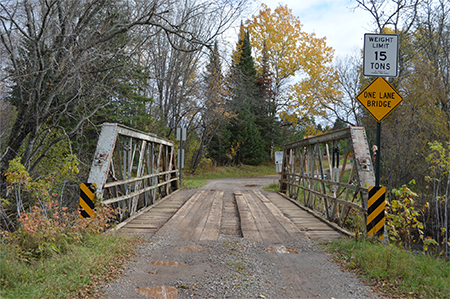 WisDOT Designation: Local – Town-owned
Current Owner: Town of Florence
Year Built: 1930
County: Florence County
Crossing: Brule River
Bridge Category: Riveted, Warren pony truss
Spans and Type: 1 span, pony truss
Overall Length and Width: 60 feet x 16 feet
National Register of Historic Places Status: Determined Eligible for listing in the National Register
Details
This one-span, riveted steel, Warren pony truss bridge with verticals carries a single lane of traffic over the Brule River. Each truss is comprised of four panels with riveted gusset plates at connections between diagonal/vertical members and upper/lower chords. Built-up diagonal and vertical members are comprised of batten-connected angle bars. Built-up upper chords, lower chords and end posts are comprised of batten-connected channel beams. The foundry mark of the Illinois Steel Company’s South Chicago works (indicated by “Illinois S USA”) is visible on some channel beams.
Diagonal steel cables were added in 1988 between floor beams and the upper portions of each end post; these are anchored to the end posts via threaded rod and nut connections. Additional midspan strengthening added at that time consisted of steel beams welded below the outer faces of both lower chords. The bridge deck is comprised of sawn timber planks that rest on steel stringers; stringers are supported by a series of steel floor beams. Two parallel railings (composed of narrow channel bars) run the length of the bridge along the inside faces of both trusses. Fixed bearings sit atop cast-in-place reinforced concrete abutments with steel sheet piling added in front of each abutment. All steel bridge components are painted, though failing paint has resulted in substantial corrosion at various locations.
History
The Pentoga Road Bridge was constructed in 1930 to carry Pentoga Road (aka Cherry Avenue) over the Brule River at the northern edge of the Chequamegon-Nicolet National Forest. Although the Wisconsin State Highway Commission (SHC) had begun to move toward wider bridges at most locations, a 16-foot-wide design was considered sufficient because of the low volume of traffic expected along Pentoga Road.
In 1928, during the period in which C.H. Kirch served as chief engineer of the SHC’s bridge division under highway engineer Walter Buetow, the subject plan called for a Warren pony truss bridge with four panels and a span of 60 feet. Besides being narrower than most SHC bridges constructed in the 1930s, the Pentoga Road Bridge was also somewhat of an anomaly as nearly all the state’s Warren pony truss bridges constructed between the 1910s and 1930s featured concrete decks, while the Pentoga Road Bridge featured a sawn timber deck. Sawn timbers may have been chosen over concrete at this location as they were more economical, could be installed in any weather, were easy to transport to remote areas and were more resistant to freeze-thaw cycles. Also, the low traffic volume on Pentoga Road extended the expected lifespan of a wood deck.
Available information suggests that Pentoga Road most likely began as a logging trail and never served as a primary transportation route between Wisconsin and Michigan. The road did not appear on Michigan or Wisconsin maps in the 1910s, indicating that it may not have been considered a public roadway at that time, as the surrounding land was largely owned by lumber companies (including the Iron Range Lumber & Cedar Company and the N. Ludington Lumber Company).
The impetus to construct a bridge at this location likely began in 1928 when the federal government commenced its acquisition of lands comprising what would become the Nicolet National Forest. When the national forest was established in 1933, one of the U.S. Forest Service’s top priorities was “the establishment of a good transportation system.” Although the Forest Service held jurisdiction over areas within the national forest, it worked in cooperation with the SHC to facilitate roadway maintenance, improvement and construction. Like most of the national forest’s roadways, National Forest Road 2446, alternately known as Pentoga Road (and as Cherry Avenue on the Michigan side), remained unpaved. But the 1930 construction of the bridge allowed for a safe crossing between Wisconsin and Michigan along this route.